

Stop relying on brute force. Discover the ancient internal technology kept secret for decades.
The program is built around five fundamental areas of development, with Energy divided into two distinct disciplines, Breathing and Qi. Together, they form the complete foundation of authentic martial development.
Why Do So Many Practitioners Hit a Plateau?
If you have been practicing martial arts for years but still find yourself relying on speed, tension, and brute muscular force (Li) when under pressure, you are not alone.
For generations, the true internal mechanics, the very engine that makes Wing Chun effortless and devastatingly effective, were stripped away or hidden. Modern practitioners are often left practicing empty external shapes, leading to physical burnout, stiff joints, and an illusion of mastery.
The solution is not to train harder. The solution is to rebuild your foundation from the inside out.
The Core Blueprint
Whether you practise Wing Chun or any other martial art, mastering these Six Core Elements will permanently transform the way you move, think, generate power, and understand combat.
Body
Develop optimal structure, alignment, posture, and body mechanics to create effortless efficiency, balance, stability, and freedom of movement.
Mind
Train focus, awareness, intent, timing, and mental clarity to remain calm, adaptable, and decisive under pressure.
Breathing (Energy I)
The gateway to internal development. Learn to breathe naturally to cultivate relaxation, regulate the nervous system, and unify body and mind.
Qi (Energy II)
Go beyond breathing to develop internal awareness. Cultivate, direct, and integrate internal energy to enhance sensitivity, recovery, and whole body unity.
Force Flow
Generate and express whole body power through relaxed movement. Develop Ging (Jing) - the ability to issue force with precision and perfect timing.
Momentum
Learn the principle of detachment. Absorb, redirect, borrow, and control momentum to flow effortlessly with changing situations.
Sifu Sergio P. Iadarola

The six core elements are the common denominator for all Chinese martial arts. They are the best way to bring ancient Chinese technology to the western world in a quick and efficient manner.
Mastering these elements is the difference between truly mastering the art and the illusion of mastery that brings Wing Chun back to a purely external art without the cultivation of real Martial Qi.
"If an egg is broken by an outside force, life ends. If an egg is broken by an inside force, then life begins. Great things happen from the inside."
— Jim KwikAdvanced Theoretical Framework
Explore the deep science and classical Chinese technology behind each of the Six Core Elements, derived from the Wing Chun ancestor systems of Emei Shi Er Zhuang and Fujian White Crane.
The body has to be brought back to its most natural and original state, rid of all unnecessary tension (Song) in order to open up the joints, sinews, and tendons so the Qi can move freely through the Yin and Yang meridians.
- Dynamic Structure (The Frame): Not rigidly holding the center by force, but naturally maintaining equilibrium.
- Uninterrupted Flow: Every muscle and tendon must be opened. The body should function like a water hose where water can run through without interruption.
- Agility & Weight: Develop the Dan Tian to make one lightweight and agile (Chin Li) while feeling as heavy as a mountain to the opponent.
The mind layer is divided into four distinct principles, moving from standard thought processes into true martial mastery.
- Thinking: The constant internal dialogue we aim to quiet during practice.
- Intention (Yi): Laser focused direction, like pointing a weapon at a target.
- Visualization: The mental imagery that directs internal sensations, crucial for early stage internal art development.
- Awareness: The ultimate state of "no mind" required for real life application. It is the background of thinking, where one simply is, free from fear, greed, and confusion (Tam Pa Mong).
Lower abdominal breathing is the first step on a journey of many layers of depth. Upper chest breathing shifts the center of gravity upwards and creates tension; lower abdominal breathing sinks the Qi and grounds the body.
- Increased Capacity: Provides approximately four times the capacity of regular breathing.
- Internal Massage: Increases oxygen rich blood flow while removing blockages from internal organs.
- Whole Body Breathing: The ultimate aim, where every pore of the body breathes, making you feel light and elevated, yet solid and heavy to the touch.
Within our curriculum, we distinguish between different types of Qi. While breathing is a form of Qi, the deep "Martial Qi" requires specialized cultivation.
- Post-Heaven Qi: Energy derived from postnatal factors (breathing and diet).
- Pre-Heaven Qi: Our original, innate genetic energy.
- Martial Qi: The result of in-depth cultivation where Jing (life essence) is transformed into pure power for martial arts, accumulating in the Dan Tian and filling the marrow.
Jin (Ging in Cantonese) runs through the energy pathways (Jin Lu). Our body needs a clear path where the Jin can run freely in order to issue force from the entire body, not just the arms.
- Unlike Brute Force (Li): Jin is developed through training, resulting in instantaneous release of concentrated energy.
- Penetrating Power: While brute force requires distance to accelerate, Jin can be released explosively from the point of contact, penetrating through the target.
- Whole Body Expression: At advanced levels, every part of the body can release Jin as an explosion from the inside to the outside.
Momentum is the product of mass and velocity. Handling our own momentum, the opponent's momentum, and the combination of both is the essence of martial arts.
- Give Birth (Sun): Using your opponent's momentum to engage in an action.
- Dissolve & Neutralize (Hua): Guiding the opponent's momentum into emptiness by absorbing it like a sponge.
- Control (Zhi) & Subdue (Ka): Controlling momentum and using spiraling energy to handle incoming force.
- Strategic Stepping: Using close-body circular and triangular steps (like the Slant Body Walk) to disrupt and take away the opponent's central axis instead of confronting power head-on.
Who Is This Blueprint For?
Who this is not for:
- Casual hobbyists looking for a "quick fix" or overnight combat tricks.
- Those obsessed only with external shapes, forms, and collecting belts without understanding the engine beneath them.
- Practitioners unwilling to empty their cup and relearn how to breathe, stand, and move.
Who this is for:
- Dedicated martial arts practitioners who have hit a physical plateau and want to unlock internal power (Ging).
- Martial artists from any system who want to integrate authentic internal technology into their existing style.
- Those experiencing joint pain or physical burnout from relying on muscular tension (Li) and want to learn to move with relaxed, spiraling energy.
Inside The Training Modules
A highly structured, progressive video curriculum. You aren't just learning theory—you are getting the exact physical drills to rebuild your engine.
Structure & The Mind
Includes specific alignment diagnostics and standing meditation routines.
- How to open the joints to allow uninterrupted force flow.
- The exact posture corrections to drop your center of gravity.
- Mental drills to transition from "thinking" to hyper-awareness.
Breathing & Martial Qi
Includes guided lower abdominal breathing and Qi directing exercises.
- How to increase your lung capacity and oxygenate the blood for rapid recovery.
- The specific techniques to stimulate the Dan Tian safely.
- How to transmute postnatal energy into usable Martial Qi.
Force Flow & Momentum
Includes kinetic drills, stepping mechanics, and partner pressure testing.
- How to release penetrating power (Jin) from a zero-distance state.
- The "Slant Body Walk" method to instantly dissolve an opponent's center axis.
- How to absorb and return kinetic energy effortlessly like a sponge.
Seamless Experience
Access the high-definition video curriculum natively from any device - desktop, tablet, or smartphone.
Lifetime Access
Your enrollment never expires. Revisit the drills, theory, and updates whenever you need a refresher.
Direct Guidance
You are not alone. Ask questions, submit video for review, and get feedback inside the private student portal.
The History of Wing Chun &
The Six Core Elements
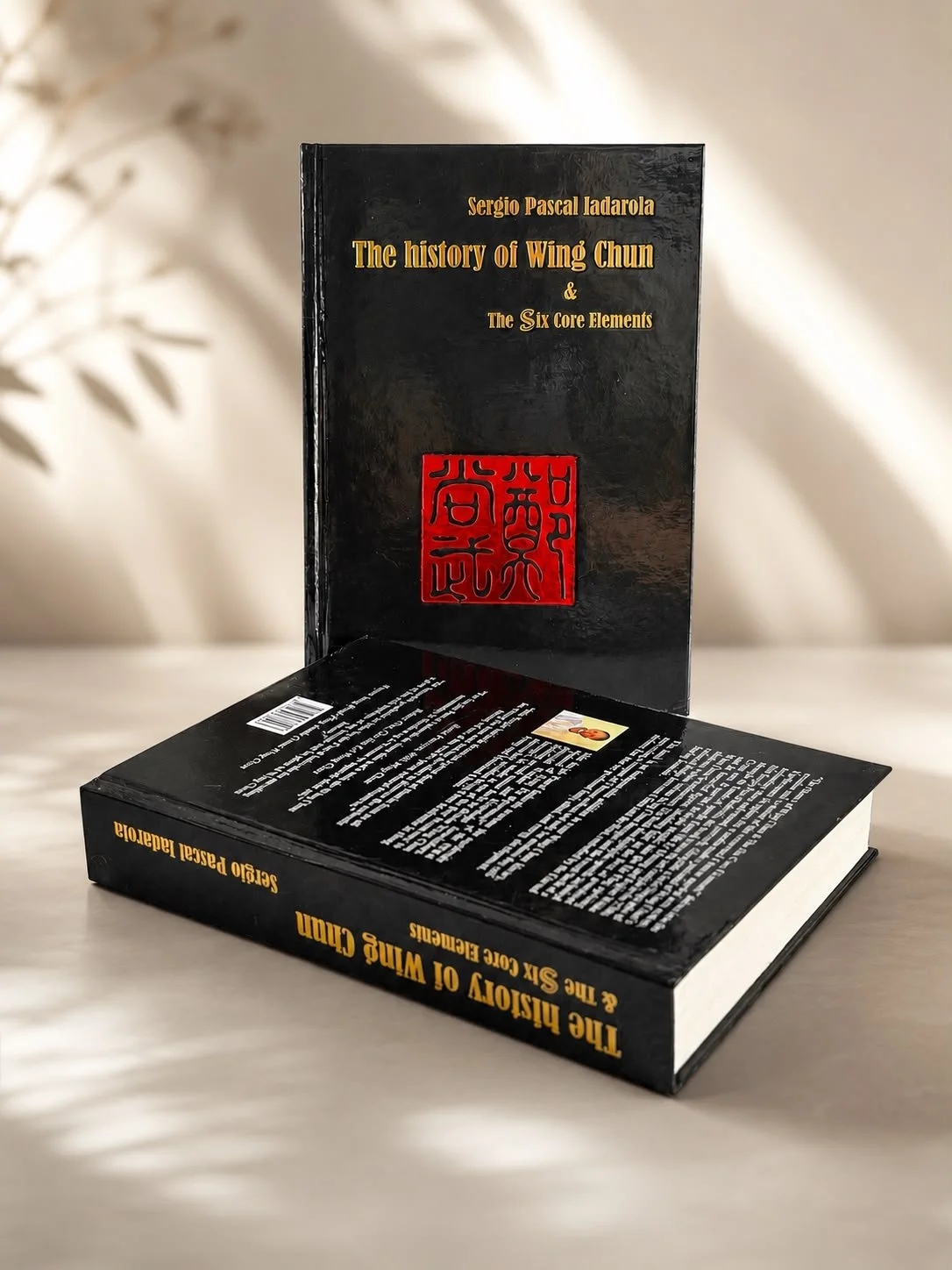
This specialized course is directly based on the comprehensive research and teachings detailed in Sifu Sergio’s essential book.
To fully absorb the principles of the internal engine and trace the authentic ancestral roots of the system, this book serves as your indispensable guide. Dive deeper into the theory and historical context while mastering the physical applications demonstrated in the course.

Voices of the Lineage
"I practiced external Wing Chun for 15 years and kept hitting a wall against larger opponents. Implementing the Six Core Elements completely rewired my structure. The effortless power (Ging) I can now generate is beyond anything I thought possible."
"Sifu Sergio has done the impossible. He has taken the mystical, hidden concepts of Qi and internal force flow, and broken them down into a step-by-step, scientific blueprint that anyone can follow."
"This isn't just about fighting. Learning to detach from force and mastering my momentum handling has brought a profound sense of calmness and awareness to my everyday life. Truly transformative."
Are You Ready to Evolve?
Do not spend another year practicing empty shapes. Join the Six Core Elements program today and gain immediate access to the internal blueprint that will transform your martial arts practice forever.
Instant Digital Access • Learn at your own pace
Commit to the Lineage
To learn these internal mechanics directly would require relocating to our sanctuary in Madeira or tracking down hidden lineages in China - costing tens of thousands of dollars and years of trial and error. Today, the complete Six Core Elements blueprint is available to you instantly.
The Six Core Elements
A single, one-time investment for full access to the complete internal system.
- Full access to all 20 premium video modules from the moment you enrol
- Free Bonus: Sifu Sergio's "The History of Wing Chun & The Six Core Elements physical book included for FREE (Shipping scheduled for the end of 2026)
- 4k UHD Video breakdowns & theory - 15 min average per video
You Are Standing at a Crossroads.
Tomorrow, you will train. You can choose to perform the same external movements, fighting against your own tension, and hitting the same plateau you've been stuck at for years.
Or, you can make the decision today to cultivate the internal engine. To move with effortless power, to detach from force, and to preserve the authentic internal development pathway lost hundreds of years ago.
Yes, I Am Ready To BeginSecure Checkout • Instant Access