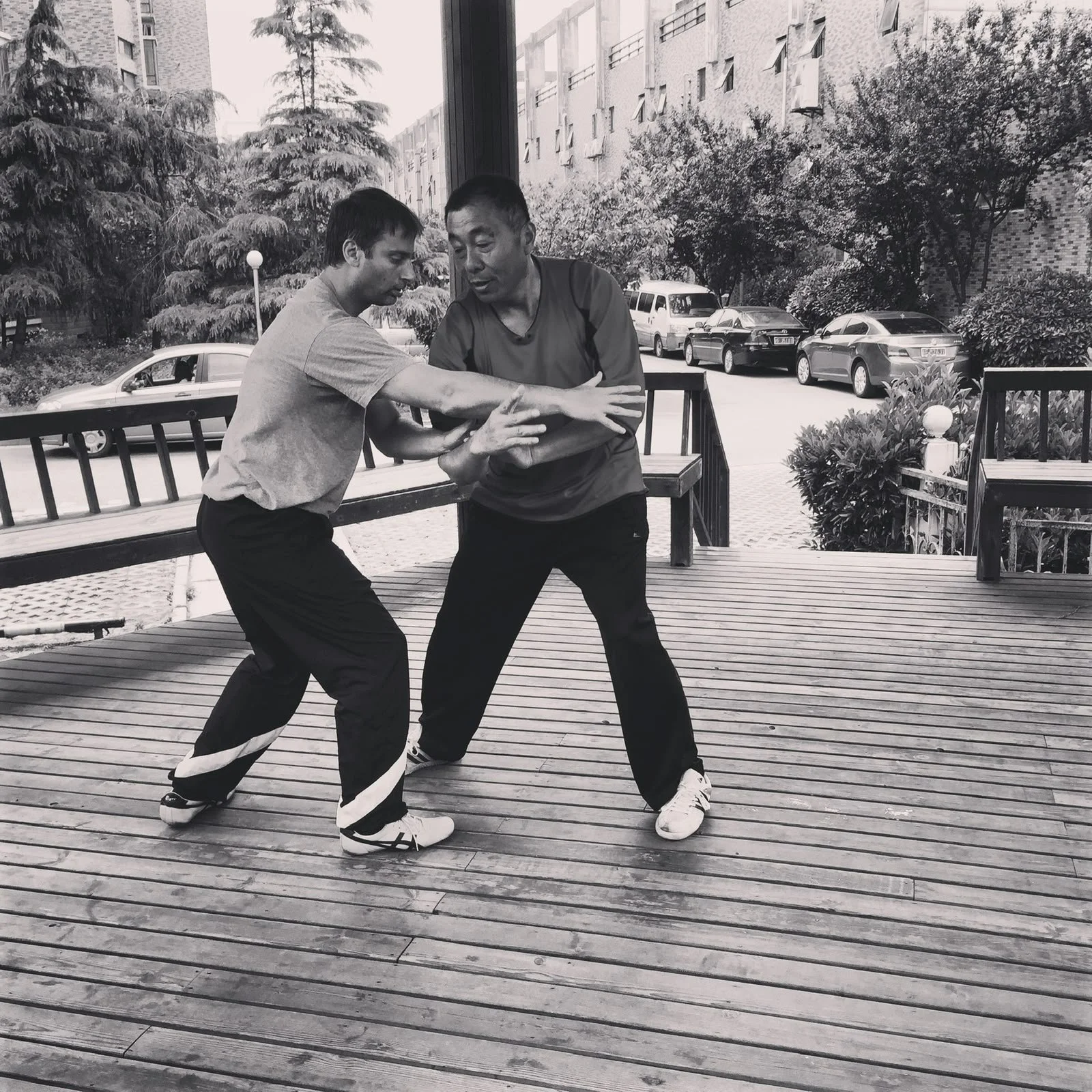
Sifu Sergio Pascal Iadarola during Tui Shou with Tian Bing Yuan, grandson of Tian Zhaolin.
Tui Shou, commonly translated as “Push Hands,” is one of the most important partner exercises in T’ai Chi Chuan and Taijiquan. Yet the English translation can give a misleading impression of its traditional purpose.
Modern Push Hands competitions can appear to be little more than two people trying to push, uproot or force each other out of a circle. But was Tui Shou originally intended to be a pushing contest?
Traditional T’ai Chi Chuan writings suggest something much subtler.
At its deeper level, Tui Shou develops sensitivity, timing, listening, neutralisation, control and issuing power. Rather than simply learning how to push another person, the practitioner learns to feel what the other person is doing before responding.
This is why “Sensing Hands” can be such a useful description.
What Does Tui Shou Mean?
The Chinese term 推手 (tuī shǒu) is conventionally translated as “Push Hands.” The character 推 means to push or move, while 手 means hand.
So, strictly speaking, “Push Hands” is the literal translation.
However, literal translation does not always communicate the purpose of a traditional practice. In Taijiquan writings, one of the central skills developed through Tui Shou is 聽勁 (tīng jìn) — commonly translated as “listening jin.”
Here, “listening” does not mean listening with the ears. It means developing the sensitivity to perceive an opponent’s pressure, direction, movement, balance, timing and intention through physical contact.
Traditional T’ai Chi Chuan teachings repeatedly describe this quality as fundamental to Push Hands. One traditional explanation connects listening with recognising changes in an opponent’s movement, followed by neutralising, controlling and issuing. (Taiji)
Therefore, “Sensing Hands” is not the literal translation of 推手, but it can describe the function and spirit of the exercise better than “Push Hands.”
Tui Shou and the Development of Jin
To understand the traditional purpose of Tui Shou, we need to understand Jin (勁).
Jin is often translated as “energy” or “power,” but in Taijiquan it refers to a refined, coordinated quality of force connected to structure, timing, relaxation, intention and sensitivity.
Tui Shou provides something that solo form practice cannot:
another human body.
When practising the T’ai Chi Chuan form, you can develop relaxation, alignment, rooting, coordination and whole-body connection. But you cannot fully test those qualities while another person is applying force.
A partner provides constantly changing information:
Where is their centre?
Where is their weight?
Which direction are they moving?
Are they relaxed or tense?
Where are they strong or empty?
When are they about to change direction?
Can you remain connected without becoming stiff?
Can you move without losing your own balance?
This is the laboratory of Tui Shou.
Ting, Hua, Na and Fa
Traditional Taijiquan writings often emphasise four closely connected abilities:
聽 — Tīng — Listening or sensing
化 — Huà — Neutralising
拿 — Ná — Controlling or seizing
發 — Fā — Issuing
These are not necessarily separate techniques. In skilled practice, they may occur almost simultaneously. 貼上的文字 (1)
Ting Jin — Listening and Sensing
Ting Jin (聽勁) is the ability to sense what is happening through contact.
Instead of waiting until your partner has already pushed, you learn to detect the beginning of their movement: a change in pressure, direction, weight or structure.
The hands are not simply pushing. They are receiving information.
Traditional T’ai Chi Chuan writings describe Ting Jin as the ability to perceive the direction and qualities of an opponent’s force, eventually extending this sensitivity throughout the whole body. (Taiji)
Hua Jin — Neutralising
Once you can sense force, you must learn how to respond to it.
Hua Jin (化勁) means neutralising or transforming force. Rather than meeting incoming pressure with pressure, you change your position, angle and structure so that the force passes into emptiness.
This reflects the Taijiquan principle of “not resisting and not collapsing,” often expressed as 不丟頂 (bù diū dǐng).
You do not run away from pressure, but you do not fight it head-on either. You remain connected.
Na Jin — Controlling
Na (拿) can involve seizing, controlling or capturing.
In Tui Shou, this does not necessarily mean grabbing dramatically. It may be as subtle as controlling the direction of an opponent’s movement, occupying their centre or preventing them from recovering balance.
Without sensitivity, control becomes crude.
Fa Jin — Issuing
Fa Jin (發勁) means issuing power.
This is the aspect most associated with Push Hands, but traditionally it was not simply about producing the biggest shove. The skill lies in issuing at the correct moment, from the correct position, with coordinated whole-body power.
In simple terms:
Ting creates the information.
Hua removes the obstacle.
Na controls the opportunity.
Fa expresses the result.
Traditional descriptions of Tui Shou identify Ting, Hua, Na and Fa as difficult skills to develop.
When Push Hands Becomes a Pushing Contest
Competition is not necessarily bad. It can provide pressure, unpredictability and a useful test of skill.
The problem occurs when winning becomes more important than developing the qualities that make Tui Shou valuable.
Once the goal becomes “I must push my opponent out of the circle,” training can easily become “I must resist whatever they do and push harder.”
Instead of asking, “What am I feeling?”, the practitioner asks, “How can I overpower them?”
Instead of developing relaxation and sensitivity, they develop tension and resistance. The result can become a form of strength wrestling that happens to use T’ai Chi Chuan techniques.
This is very different from the traditional emphasis on listening, sticking, yielding and responding. Historical discussions of Push Hands warn against relying too heavily on muscular strength and emphasise understanding an opponent’s force instead.
Pushing Someone or Feeling Someone?
Imagine two practitioners practising Tui Shou.
The first is thinking:
“I need to push them.”
The second is thinking:
“I need to feel them.”
They may perform the same external movement, but internally they are practising different skills.
If you only practise pushing, you may become good at pushing. If you practise sensing, neutralising, controlling and issuing, the push becomes the result of a deeper skill.
That is why “Sensing Hands” is such a useful phrase. It reminds us that the objective is not simply to move another person, but to understand their movement through contact.
What Did Tui Shou Look Like in the Past?
It is important not to romanticise the past. There was no single historical version of Tui Shou followed by every Taijiquan practitioner, and terminology varied between teachers and lineages.
Historical sources refer to related practices by names including 打手 (Da Shou, “striking hands”), while terms such as 搭手 (joining hands) and 揉手 (rolling hands) have also been used. One historical discussion notes that Da Shou was an older term and that Tui Shou became increasingly established during the nineteenth and early twentieth centuries.
The claim that “Tui Shou originally meant Sensing Hands” should therefore be treated cautiously.
Linguistically, 推手 means “Push Hands.” But the purpose of the traditional practice can be understood through the concept of sensing or listening.
The emphasis was not necessarily on the visible act of pushing. It was on what happened before the push: listening, sticking, following, neutralising, controlling and issuing.
Why “Sensing Hands” May Be a Better Description
Push Hands:
Two people push each other and attempt to unbalance one another.
Sensing Hands:
Two people maintain contact and use that contact to develop sensitivity to movement, pressure, balance, timing and intention.
The second description tells a beginner more about what they should actually be learning.
The physical push is only one possible expression of the practice. The deeper skill is sensitivity.
Some modern T’ai Chi Chuan schools have therefore adopted “Sensing Hands” or “Listening Hands” as alternative names for Tui Shou.
Developing Sensitivity Before Strength
A useful progression in Tui Shou is:
Relaxation → Contact → Sensitivity → Listening → Neutralisation → Control → Issuing
The mistake is to reverse the process:
Strength → Resistance → Competition → Pushing
When strength becomes the priority, the practitioner often becomes tense. As tension increases, sensitivity decreases, creating a cycle in which even more strength is needed.
A skilled practitioner should be able to receive pressure while remaining relaxed, maintain structure without rigidity and respond to change without unnecessary muscular effort.
The challenge is not simply to become stronger.
It is to become more perceptive.
The Real Test of Tui Shou
The real test of Push Hands is not:
“How hard can I push?”
It is:
“How clearly can I feel?”
Can you feel when your partner’s weight changes?
Can you recognise when their structure becomes committed?
Can you neutralise force without fighting it?
Can you maintain contact without becoming rigid?
Can you remain balanced while your partner loses balance?
Can you issue power without first becoming tense?
And can you remain calm enough to feel what is actually happening?
That is where Tui Shou becomes much more than a pushing exercise. It becomes a method for developing martial sensitivity.
Returning to the Traditional Spirit of Tui Shou
Modern competitive Push Hands has its place. It introduces pressure, unpredictability and resistance, and it can expose weaknesses that cooperative practice may hide.
But competition should not be confused with the entire purpose of Tui Shou.
If practitioners focus exclusively on pushing, resisting and winning, the subtler qualities of T’ai Chi Chuan and Taijiquan can become secondary.
The traditional principles point in another direction:
Listen before you move.
Feel before you act.
Yield rather than resist.
Follow rather than chase.
Understand the force before attempting to control it.
And only then:
Issue.
Perhaps this is why “Sensing Hands” resonates with so many practitioners. It reminds us that the real conversation is not about pushing.
It is about feeling.
The hands make contact, but the whole body listens. And the better we listen, the less we need to force.
Tui Shou: The Art of Listening Through Contact
Tui Shou is often translated as Push Hands, but its deeper purpose goes far beyond pushing.
Through the development of Ting Jin, Hua Jin, Na Jin and Fa Jin, practitioners learn to sense, neutralise, control and issue force while maintaining relaxation, balance and connection.
The goal is not simply to move another person.
The goal is to understand them through contact.
That is the difference between pushing hands and sensing hands — and a key to understanding the traditional partner practice of T’ai Chi Chuan and Taijiquan.