





Online Academy
At the heart of our academy is a deep and immersive curriculum in Internal Wing Chun. This refined system combines rooted internal development, meditative precision, and real-time instructor guidance. A complete digital pathway for those seeking authentic transformation in the internal martial arts.
About Curriculum
Online Curriculum Overview
- Weekly structured lessons with downloadable training resources for guided home practice
- Core foundational practice based on the 1700 ancient Single Set Siu Lin Tau
- Zhan Zhuang (Standing Like a Post) — standing meditation to develop structure (The Frame), awareness, and Hei (Qi) aquire real internal power
- Qi Gong, Nei Gong, through specialised cultivation routines designed to build authentic internal power, resilience, and longevity
- Deep training in Song (鬆) and Ting (聽) to cultivate true relaxation, sensitivity, and refined internal skill
- Internal and external frame development to elevate your Chi Sau and Lat Sao
- Cultivation of Hei (Qi) to develop REAL sticking skills to up your skill in Chi Sao and Gor Sao
- Ancient cultivation methods preserved from Wing Chun’s ancestral arts
- Cultivation of San, Yi, and Hei (Shen, Yi, Qi) — aligning spirit, intent, and energy into a unified internal system
This syllabus covers the physical and technical training methods through which Wu Taijiquan skill is embodied and applied.
Students train:
- Wu Taijiquan Short Form and applications
- Wu Taijiquan Slow / Long Form and applications
- Wu Taijiquan Fast Form and applications
- Progressive Tui-Shou (Push Hands):
- Basic Tui-Shou
- Fixed-step Tui-Shou
- Tui-Shou with footwork and applications
- Solo drills for alignment, rooting, and whole-body connection
- Partner drills for listening, neutralising, sticking, and issuing
- Issuing methods (Fa Jin) expressed through structure and timing
- Complete Wu Taijiquan weapons system, including:
- Two Swords
- Saber
- Spear
- Pole
- Weapons applications preserving Wu Taijiquan body method and internal quality
Purpose:
To build a Wu Taijiquan body that functions with relaxation, structure, and efficiency, across solo practice, partner work, and weapons.
- Song — deep relaxation without collapse
- Peng, Lü, Ji, An as structural and functional principles
- Ting (listening), Hua (neutralising), Nian (sticking), Sui (following)
- Central equilibrium and vertical alignment
- Rooting and ground-path force transmission
- Yin–Yang transformation in movement and interaction
- Timing, angle, distance, and positional advantage
- Issuing power (Fa Jin) without tension
- Maintaining Taiji quality under speed, pressure, and resistance
- Consistency of principles across empty hand, Tui-Shou, and weapons
This syllabus explains how and why Wu Taijiquan works, guiding every exercise, form, and interaction.
Students study and embody:
Purpose:
To ensure Wu Taijiquan is practised as a principle-driven internal art, not choreography or external technique.
Internal Growth · Health · Longevity · Lineage
This syllabus addresses long-term internal development, health, and the deeper internal aspects of Wu Taijiquan practice.
Students cultivate:
- Integrated body–breath–mind coordination
- Calm awareness and embodied presence
- Efficient circulation of internal energy through relaxed structure
- Development of Yi (intent) as the primary driver of movement
- Refinement of internal power (Jin) through consistent practice
- Emotional balance and mental clarity through Taiji training
- Longevity-oriented practice preserving joints, spine, and nervous system
- Internal consistency across daily life, not only training
- Responsibility and maturity required for lineage transmission at advanced levels
- Establish correct Wu Taijiquan body structure, alignment, rooting, and central equilibrium
- Cultivate Song (relaxation), coordination, and whole-body movement
- Learn the Short Form and its martial applications
- Progress into the Slow / Long Form, developing continuity, balance, and internal connection
- Develop sensitivity and partner awareness through basic Tui-Shou (Push Hands)
- Learn to maintain Taiji principles under interaction and light pressure
- Train the Fast Form, expressing speed without loss of structure or relaxation
- Practise fixed-step Tui-Shou and applied Taiji techniques
- Develop listening (Ting), neutralising (Hua), sticking (Nian), and issuing (Fa Jin) skills
- Apply Wu Taijiquan principles through structured partner drills and applications
Wu Taijiquan — Foundation to Functional Skill
Across the Apprentice, Intermediate, and Advanced levels (Levels 1–9), students are progressively guided from foundational structure into functional Wu Taijiquan application, while maintaining internal quality at every stage.
Through these levels, students learn to:
Outcome:
By the end of the Advanced level, students possess a solid internal foundation, functional Wu Taijiquan application, refined sensitivity, and the ability to express Taiji principles dynamically while remaining relaxed and rooted.
Wu Taijiquan — Mastery, Weapons & Transmission
Across the Elite and Disciple levels (Levels 10–12 + Disciple stages), training moves beyond skill development into complete integration, weapons mastery, and lineage responsibility.
Through these levels, students learn to:
- Maintain Taiji structure, balance, and internal power under full movement and pressure
- Practise Tui-Shou with footwork and advanced applications
- Express Wu Taijiquan principles freely in dynamic partner interaction
- Train the complete Wu Taijiquan weapons system, including:
- Two Swords
- Saber
- Spear
- Pole
- Apply Taiji principles consistently across empty hand, partner work, and weapons
- Refine issuing power (Fa Jin) with precision, timing, and control
- Preserve internal quality across speed, distance, and complexity
- Internalise the classical principles and deeper logic of Wu Taijiquan
- Develop the maturity and responsibility required for lineage representation and transmission
Inside the Eternal Spring Instiutute
At the Eternal Spring Institute, students are guided through a structured and progressive training system consisting of multiple levels: Apprentice, Intermediate, Advanced, Elite, and Disciple. Upon reaching the Disciple level, a student may be accepted as a closed-door disciple through the traditional Bai Si (tea ceremony), signifying a formal and deeply respected commitment to the lineage.
After approximately three to four years of dedicated and intensive training, eligible students may apply for private instruction and invitation-only closed group training. These advanced studies focus on refined internal development and long-term cultivation, deepening skill through advanced Qigong and Nei Gong methods, detailed study of the Kuen Kuit (fist poems) and their underlying principles, and practical applications intended to prepare students for responsible transmission and guidance of others.
Sifu Sergio’s Path
Sifu Sergio’s approach is shaped by decades of rigorous training across Hong Kong, China, Taiwan, Singapore, New Zealand, and Canada, blended with modern insights gained through sustained practice and deep personal exploration. His teaching method bridges classical tradition with contemporary understanding, allowing students to cultivate authentic internal strength, refined awareness, and lasting self-mastery in a way that is both traditional and highly functional.
Structure of the Program
Wu Taijiquan is known for its refined structure, subtle internal mechanics, and emphasis on listening, neutralisation, and whole-body power. Through this program, students study the complete Wu Taijiquan curriculum, including short, long, and fast forms, progressive Tui-Shou (push hands) training, practical applications, and the traditional weapons system. Training develops real internal skill while preserving Wu Taijiquan’s characteristic softness, precision, and depth.
The Wu Taijiquan program at the Eternal Spring Institute is guided by the lineage of Sifu Zhou Zhong, a Wu Taijiquan master in direct line from Wu Jianquan. His teacher, Fei Guoqing, and his father, Zhou Qingxian, were both direct indoor disciples (入室弟子) of the legendary grandmaster Ma Yueliang. From a young age, Sifu Zhou was personally brought to train with Ma Yueliang in the park, where he received direct guidance from the great master himself. This threefold direct transmission forms the foundation of Sifu Zhou Zhong’s deep understanding and authentic skill in Wu Taijiquan.
Taught under the auspices of the Eternal Spring Institute on the beautiful island of Madeira, the Wu Taijiquan Online Program provides direct access to genuine internal transmission, allowing students worldwide to develop real Taiji skill, internal balance, and long-term vitality without the need for extensive travel. This pathway preserves the depth, integrity, and living essence of Wu Taijiquan, while making it accessible through structured modern online study.
Subscription
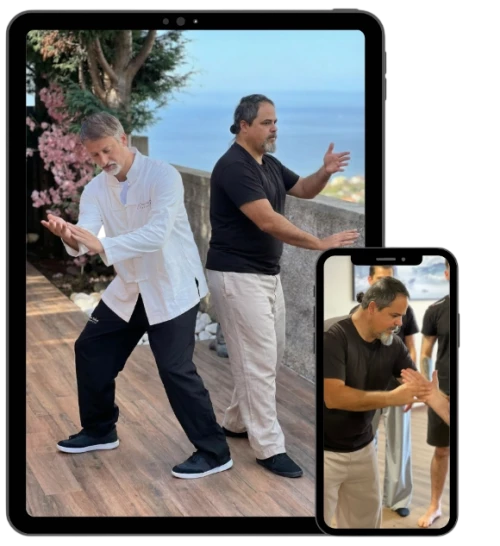
- Complete Wu Taijiquan internal system — form, partner work, weapons, and cultivation
- Short, Long, and Fast Wu Taijiquan forms with real martial application
- Progressive Tui-Shou (Push Hands) for sensitivity, balance, and issuing power
- Deep internal principles: Song, structure, listening, neutralising, and Fa Jin
- Traditional Wu Taijiquan weapons system (Sword, Saber, Spear, Pole)
- Authentic lineage transmission rooted in the teachings of Ma Yueliang